
One thing I think about a lot — and suspect many others do as well is the tension between how a thing looks and how it’s meant to be used. In my brain, function comes first. Always. Nonnegotiable. Hearing otherwise makes me want to reach for a mallet and do some head bopping. A chair has to hold a human being, or cat, or suit of armor without wobbling. A cabinet has to carry its load without sagging or falling off the wall. A table has to actually hold the dinner (or, later, dancers) without threatening collapse; the people or skeletons sitting around it have to be able to fit their lower extremities underneath without attracting splinters.
That doesn’t mean things can’t be beautiful, or daring, or out in the meadow chasing butterflies. But when form tries a coup d’état over the intended use of the object, the result is failure — or the installation of a military-style junta, neither of which are good long-term modes of existence.
I’ve had reminders of this in my own work. Not long ago, I built a dining table that looked fine on paper, and even after the fact as a fully formed object made out of wood. However, once it was assembled, and the very large and heavy ambrosia maple top was fitted, the base swayed laterally…enough to make me question the whole design, and rightly so becuase that thing just wasn’t going to make having a dinner party pleasant. The fix turned out to be simple, at least in principle: triangles. A bit of structural bracing after the fact and some careful adjustments to blend them in as much as possible, and the table became steady without changing the look. Maybe it became even a little more balanced proportionally. At least I think it did. And so did the client, because that’s what they told me (Unless they were lying to make me feel better. Either way it doesn’t matter. I got paid!). That’s a trade I’ll make every time.
Woodworking, in that sense, for me, is a kind of philosophical dialogue you can sit on, store things in, or eat dinner off. Every project begins with the same questions: What is this thing supposed to do? How can I make it do that thing as well as possible? How can I make it look attractive or pleasing to the eye and touch. If one can achieve both in one go, its a job well done. If not, no amount of flash and filigree is going to save the project or your soul from torment. Not the eternal kind. Just everyday torment.
A Magnificent Disaster
Which brings me to architecture — specifically, Frank Lloyd Wright’s Fallingwater. Uh oh. This guy’s not an architect. He’s gonna say something that he’s going to regret. This ought to be good. Let’s see where this goes.
A magnificent disaster. That universally celebrated, iconic, endlessly photographed house in my former western Pennsylvania stomping ground. On paper, it is a real gem. In person, visually, in its setting, sublime. As a house? It leaks, rots, and requires constant repair. Millions upon millions. A triumph of vision and design? Sure. But one that stumbles at its most basic purpose. If the function of a home is to provide shelter, then Fallingwater is a masterpiece with a bucket in every room.
If being a livable house was its true intent, its function, and it was not created as just a remarkable design statement by someone given carte blanche to go nuts — bad architect. Go to your room now and think about what you’ve done. If the intent was to make a livable home, that intent lost the fight. TKO. And if you think that’s an unfair standard, I’d ask you this my dear reader and potential wealthy patron: What’s the point of a house that fails at being a house? What’s the point of a cabinet if it falls off the wall after you put your wares inside?
I point this out to to underline the principle: when form overwhelms function, you’re not going to be able to stop the cracks from showing. Maybe they won’t show right away, but they will in the end. [And yes, sometimes those cracks on the ceiling will have the habit of looking like a rabbit.]
Fallingwater’s problems aren’t just a distant architectural discussion in my brain. They’re a reminder that ignoring the core purpose and practicality of a thing — or the limits of one’s chosen materials — will come back to chomp on you Night of the Living Dead-style. I’m not pouring concrete cantilevers over a waterfall in my shop, but the principle is the same. If I forget that a chair has to hold a human being, perhaps a frail one with brittle bones, without wobbling, or that a cabinet door ought to open without needing the Jaws of Life, I’m making my, and maybe your own smaller, leaky version of Fallingwater.
Every project is a balancing act, a negotiation between what looks right and what works right. Some days, function wins by a mile. Other days you come up with something to remind yourself it’s not all about utility. But the moment you start letting form push function out of the driver’s seat entirely, you’re on the super highway to leaks and rot and lots of scratch down the waterfall in revisions, repairs, and replacements. I’ve seen where that ends. I don’t like it.
This doesn’t mean I’m a pure utilitarian and sacrifice design at all costs. The sweet spot is where the two meet and feed each other, where the form isn’t just decoration, but a product of solving the functional problems well. That’s where a piece earns its keep. Literally. You’ll want to keep it and not treat it as dumpster-grade furniture.
So yes, I’ll admire Fallingwater from a respectful, dry distance. But if you hand me the keys, don’t be surprised when I politely hand them back and ask if you’ve got something else, perhaps one that I can actually stand upright in without hitting my head on the ceiling or need a multimillion dollar endowment to keep it upright.
Okay. Now get out those bows and arrows and turn me into a pincushion a la the late, great Toshiro Mifune in Throne of Blood. That guy had form, all right. And plenty of function to match. Ha!
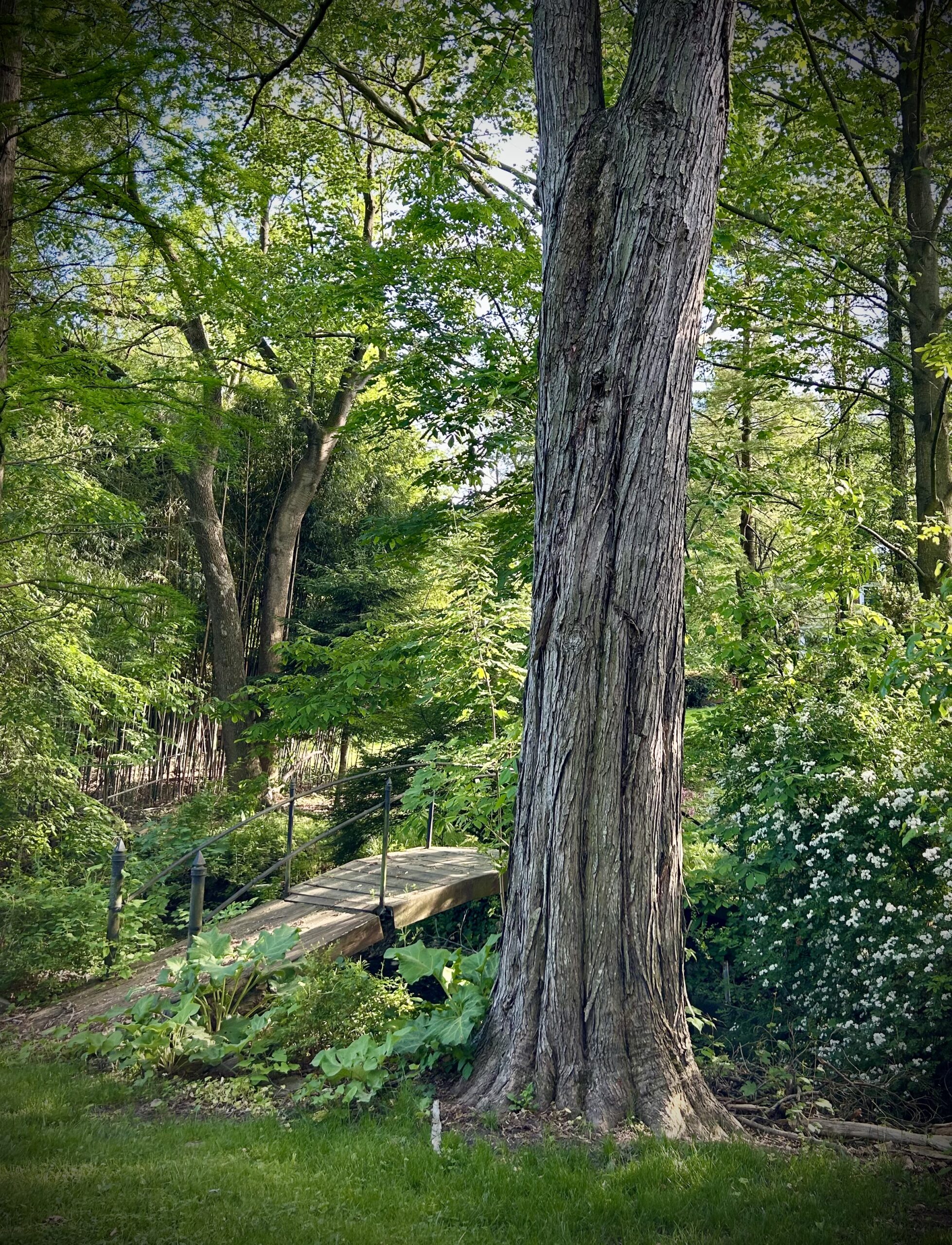
Addenda: I wanted to post an image of Fallingwater here, but I’m afraid that probably runs afoul of copyrights and I don’t want to get sued. I actually have a couple exterior shots I took probably 20 years ago on a visit, but the images are on 35mm slide film. Anybody out there still know what a “chrome” is? Probably not. No matter. So, the image I give you is of a photo of a large silver maple on my property next to the little bridge that goes across the little stream.


Leave a Reply