
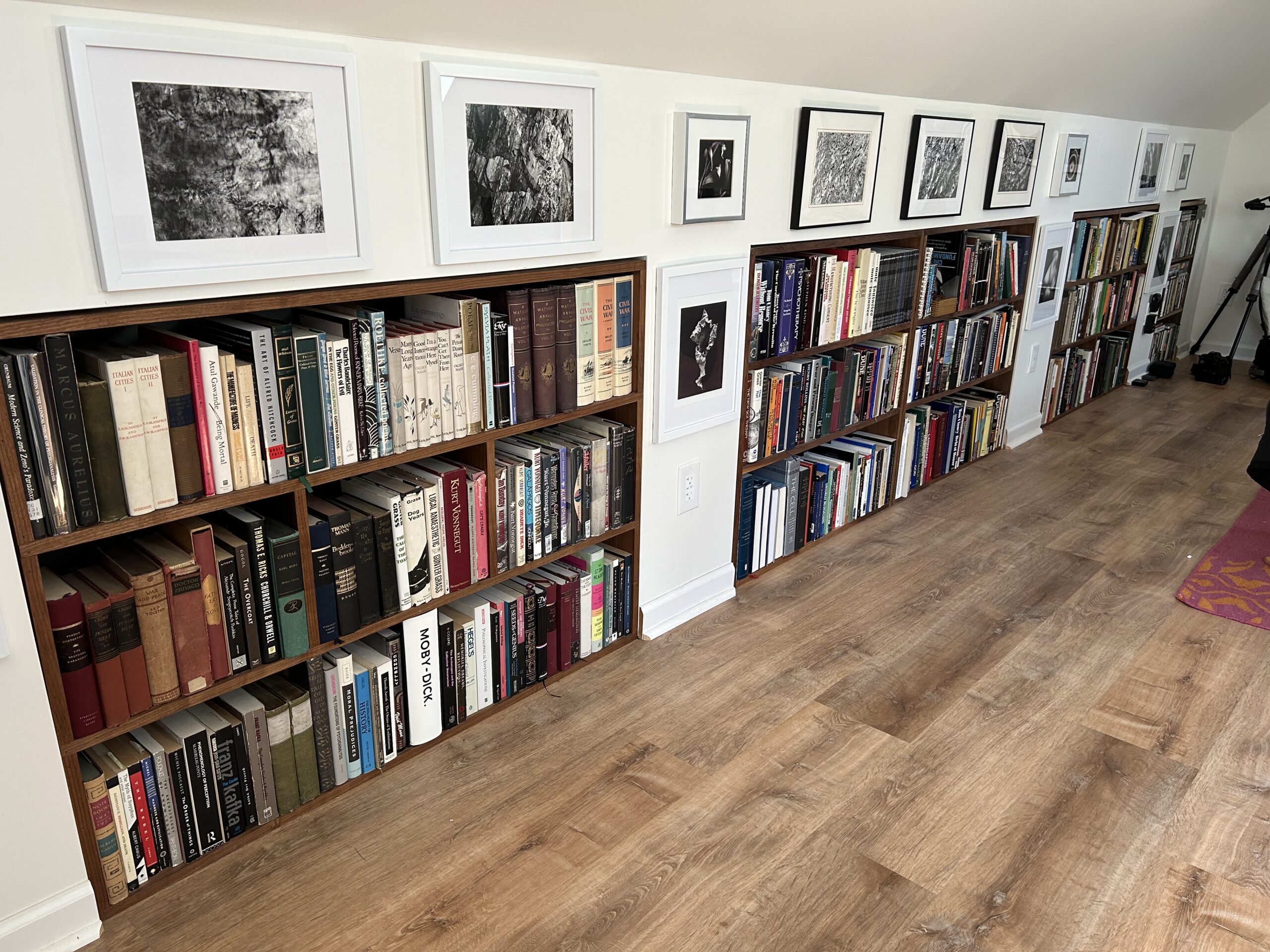
When you get down to the heart of matter, I think there are two basic modes of furniture design and creation – one that starts with a fully realized piece, the other that begins with an individual’s need, want, desire. One approach is neither better nor worse than the other. Just different. It just so happens that MP Woodworks primarily occupies the space of the latter versus the former.
I would say the former is of a kind like this: I have come up with X style for a dining table. It is of size Y, its wood is Z. And it will cost you such and such quid. Care to make a purchase? I think there’s also a variant of this that goes: this is an example of a table in style X. You can have it in A, B, or C configuration for XX quid. Care to make a purchase?
The latter goes a little something like, “Hello, Mr. X. You were referred to me by my friend Y. I have this room in my house that I’m converting into a study and I’m in dreadful need of some shelving for my collection of books and scrolls, along with my assortment of shrunken heads and other artifacts of past travels. Would you be willing to meet to discuss some possible options?
And to this, I would say, who are you, Indiana Jones? Yes. Yes, I would like to meet and discuss your project.
Now, in this scenario, the conversation absolutely does not begin with talk of wood species, joinery, or a monograph on human labor in late-stage capitalist economies. The conversation starts with questions about the non-negotiable realities that must be accommodated by the furniture or cabinetry one desires. So, we’re talking about – in DETAIL – for example, the following: Tell me about the room, its dimensions, windows, flooring, things staying, things being removed.
Show me the books, scrolls, heads in question. Will you be procuring more? Approximately how many, how frequently? Do you routinely read and interact with some, most, all of the items that will be resting comfortably on said shelving? Do you want the structures or objects to blend into the existing architecture and style of the space, or become a focal point of distinction? Children, grandchildren, pets? Do you anticipate being tracked down by hostile third parties because you illegally looted antiquities from within their sovereign borders?
I would say that more often than not, when it comes to purely custom work, it is less about designing a piece of furniture or cabinetry and more about designing around the habits and lived reality of the individuals using the objects for their intended purpose in the desired location.
My job would, for example, never be to say to you: you have 4,000 books. Well done, old chap. Would you consider getting rid of some of them? My job would be to say, given the size of your collection, the space, and the other parameters we’re working with, here’s what I can realistically accomplish in this scenario without knocking down walls. Because, again, practical realities are often the limiting factor rather than budget, time, skill, or anything else. Books are the size they are. People are the size they are. Pretending otherwise serves no purpose beyond proving one’s stubbornness and inability to adapt to the present situation.
So, I would say then that the quality of the solution, i.e., the design of whatever the person is after, depends on whether one has correctly identified and honestly accepted the non-negotiable givens of the task at hand.
I think the approach ought to be one of disciplined thinking applied to real materials, real people, real-world constraints. That’s how I conceptualize it.Only after all that is worked out do we get to picking wood and finishes, and sketches, and timelines, and budgets. So, when I get out my portable spotlight and begin the interrogation, and you start thinking to yourself ‘I wasn’t expecting a kind of Spanish inquisition,’ remember that the conversation isn’t a formality before the work starts, it is the work.


Leave a Reply