
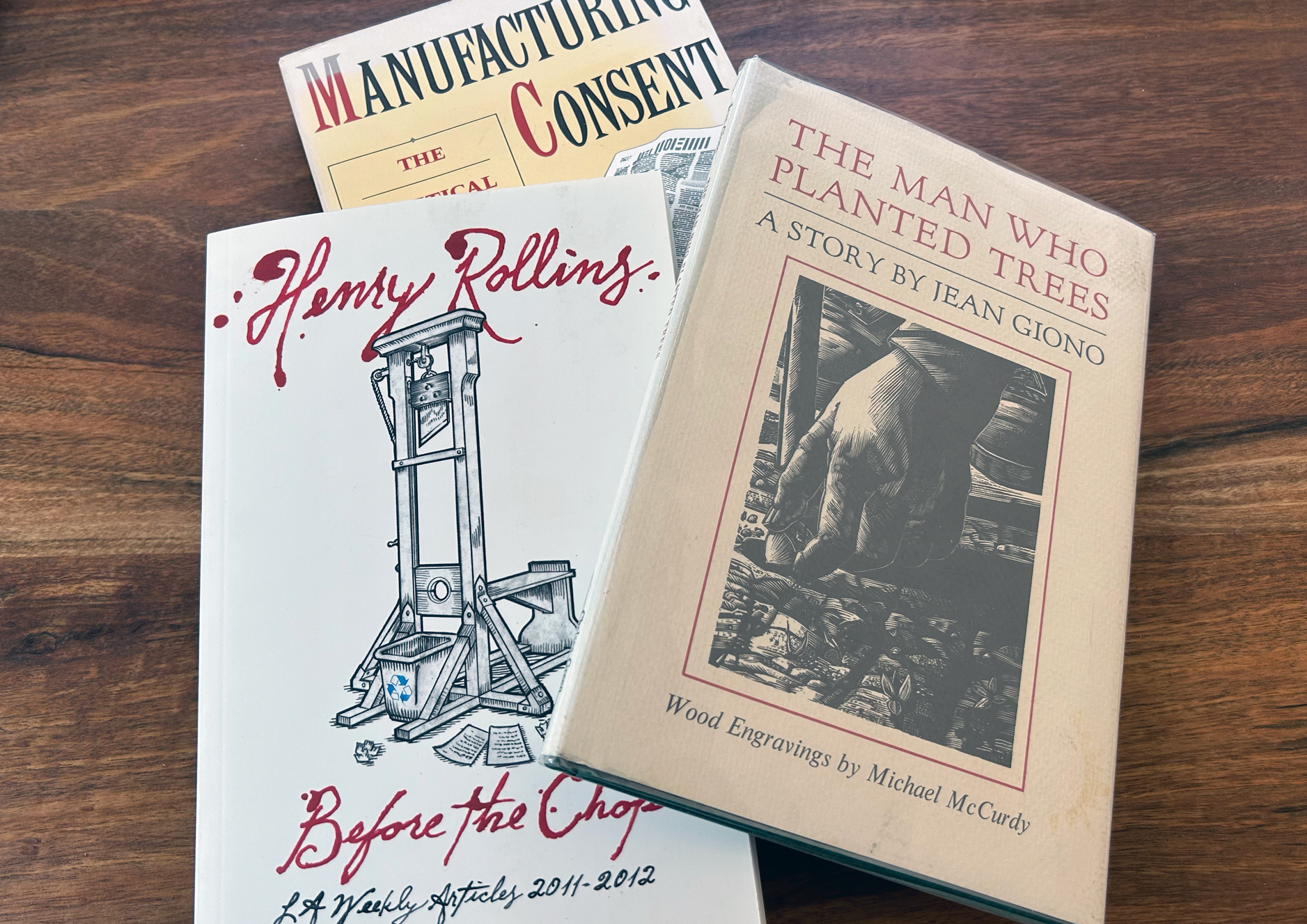
I’m pretty sure what I’m about to write is not an entirely original idea. I’m 99% certain I’ve seen this trope before in other contexts and was amused. So, I’ll steal said trope for repurposing. Maybe even in this context. I don’ know. So, my apologies in advance should any of this sound familiar.
Looking at the bookshelves in my office this morning, I thought of a mental exercise to stir up the creative juices – taking a title of book that has absolutely nothing to do with the art and craft of woodworking and come up with a premise that does.
A Farewell to Arms, by Ernest Hemingway: Memoir of a really inattentive woodworker and his/her misfortunes around power tools.
Before the Chop, by Henry Rollins: An explication on the adaptation of the guillotine to cutting mortises. Note: See also essay: Reflections on the Guillotine, by Albert Camus in Resistance, Rebellion, and Death.
The Last Temptation of Christ, by Nikos Kazantzakis: A humble carpenter thinks about giving up his hand tools for the convenience and speed of a power tool life.
The Man Who Planted Trees, by Jean Giono: A solitary man replants an entire forest by hand over decades only to chop it all down again to make some furniture for sale.
The Limits of Power, by Andrew Bacevich: A monograph on the superiority of hand tools in an electrified world.
Create Dangerously, an essay by Albert Camus: An exploration of how to go about nearly losing all one’s appendages to power tools, but not, and arrive at a state of creative clarity.
Clear and Present Danger, by Tom Clancy. Operator’s manual for a table saw.
Manufacturing Consent, by Noam Chomsky and Edward Herman: Exploration of how Ikea came to dominate the furniture world, one crappy bookcase at a time.
Either/Or, by Soren Kierkegaard: Polemical essay on why one must necessarily choose to either be a hand tool woodworker or power tool woodworker, but not both at the same time.
Advertisements for Myself, by Norman Mailer: A writer’s collection of writings showcasing how profoundly dubious of a writer one can be at times, get away with it, yet still be a Norman Mailer.
And…That is quite sufficient.


Leave a Reply