
Custom chess board in maple, walnut, and cherry
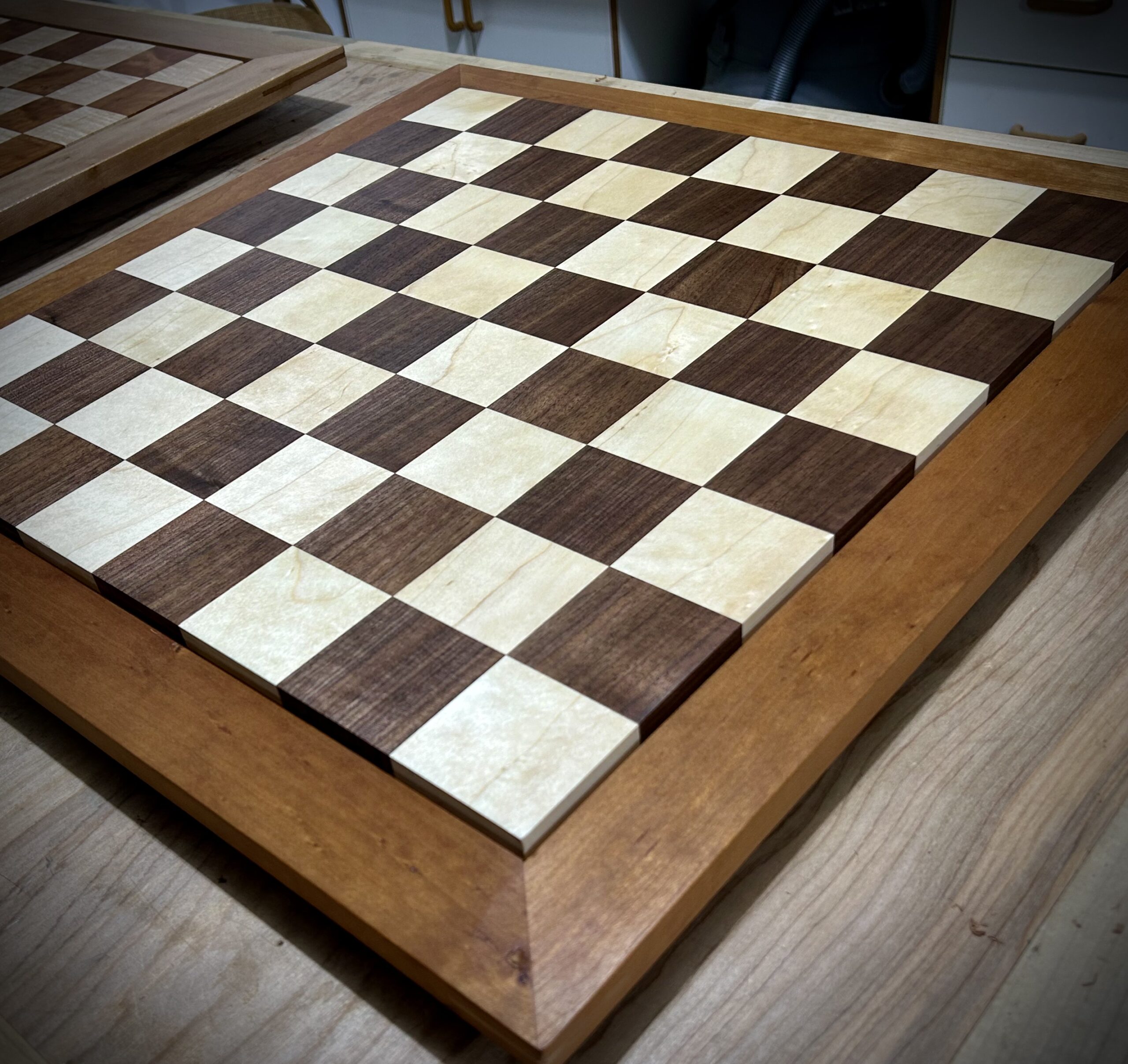
- Project: Custom chess board in maple, walnut, and cherry
- Project Category: Furniture and objects
- Completion Date: May 2025
Project Overview
- Custom chess board in maple, walnut, and cherry. Solid wood construction. Playing aree is maple and walnut. The border is cherry w/ decorative walnut splines at corners (not visible). This was “old cherry” I purchased from my local mill that had found it at a supplier and had been sitting for decades unused. Essentially oxidized dark red all the way through. Kind of like it was roasted/torrefied, but not. Very cool to find and use. Still have about 10 board feet left for future projects. Very tight growth rings. Big, old, tree.
- Playing surface is raised 1/4″ above top of border
- Frame is mitered and affixed to playing surface w/ tongue and groove joint, pinned in the center to allow for expansion/contraction. 1/8” expansion gap between border and playing area
- Design Note: I have pretty much standardized my design and construction of chess boards to a couple different options that can be made with about any kind of wood and at any size, from regulation tournament dimensions down to small table top or travel sizes. They are not what I would call overly ornate. They are solid and made for serious playing. My boards are all made of solid wood for both the playing field and whatever border encapsulates it. Because of this method, I have to leave an expansion gap between the board and the border in the event the playing field needs to move due to seasonal humidity changes. It’s kind of like a frame and panel door design, if you know what I mean. The playing field is only affixed in the middle third with glue and sometimes wooden pins on the underside to keep it rigidly in place that go through the playing field and into the tongue on the border. I will either make the playing field flush with the border, or thicker so that it is raised above the border about a quarter inch. I like the latter style personally. Borders can be made in any dimension from skinny to super wide. Almost always they are mitered with decorative splines. Sometimes I will make the playing field 10 squares by 10 squares and use the extra rows to create an integrated tongue that fits into a groove on the border, which is opposite the way described above. This is kind of neat sometimes.
Details
- Materials
- Playing field: Hard maple and black walnut
- Border: Old cherry (see above)
- Finish
- Sutherland Welles Botanical Tung Oil Low Lustre with a final topcoat of beeswax
- Construction
- Joinery Methods:
- This board is set into a mitered frame with tongue and groove joinery. Frame has decorative splines in the the corners in walnut. I do not use hide glue for my boards because of its rigidity. In my experience, PVA wood glues are the best option for these, but that’s just me.
- Dimensions:
- Overall Dimensions: 22″ x 22″ x 1″. Playing field is 18″ x 18″ x 1″ (2.25 inch squares). Border is 2″ wide x .75″ thick.
- Joinery Methods:
- Timeline
- Project duration: ~Three days for stock selection (unless I need to source specific materials not currenlty in my inventory) and milling, glue-ups, and general construction of the playing field and border. Finish needed 3 coats, each one taking 1-2 days for application and adequate drying between coats, plus the final waxing which only takes about 20 minutes
Interested in something similar?
- Contact us to discuss your project. We can make boards, cases, boxes to hold your board and pieces, or any other chess playing paraphanelia you might own. Note that I don’t typically turn/make complete chess piece sets on the lathe. I’m happy to discuss options, though depending on what you’re looking for, you may be better served by purchasing sets from a notable supplier, which I can recommend if you are having a board made as a gift for someone and are not well-versed in where to find quality sets, what sizes you need to match your board size, etc.
- Our goal is to design, build, and install pieces that fit your life and your style. No project is too small. Some are too big. All depends. Give us a call to discuss your next project.