
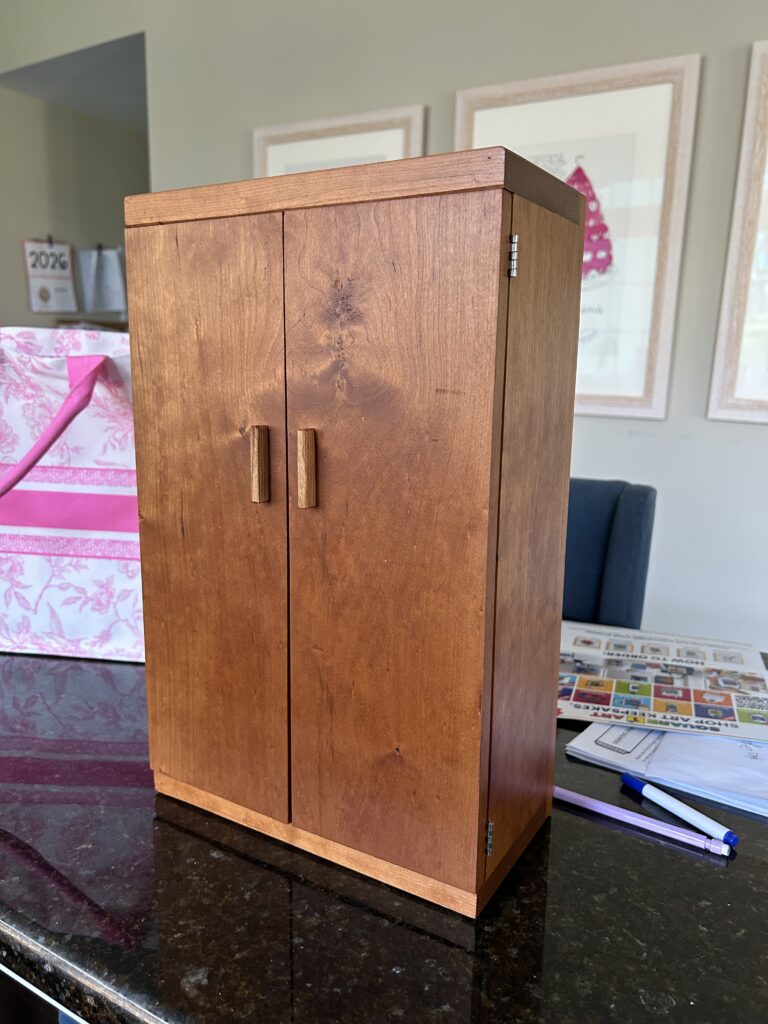
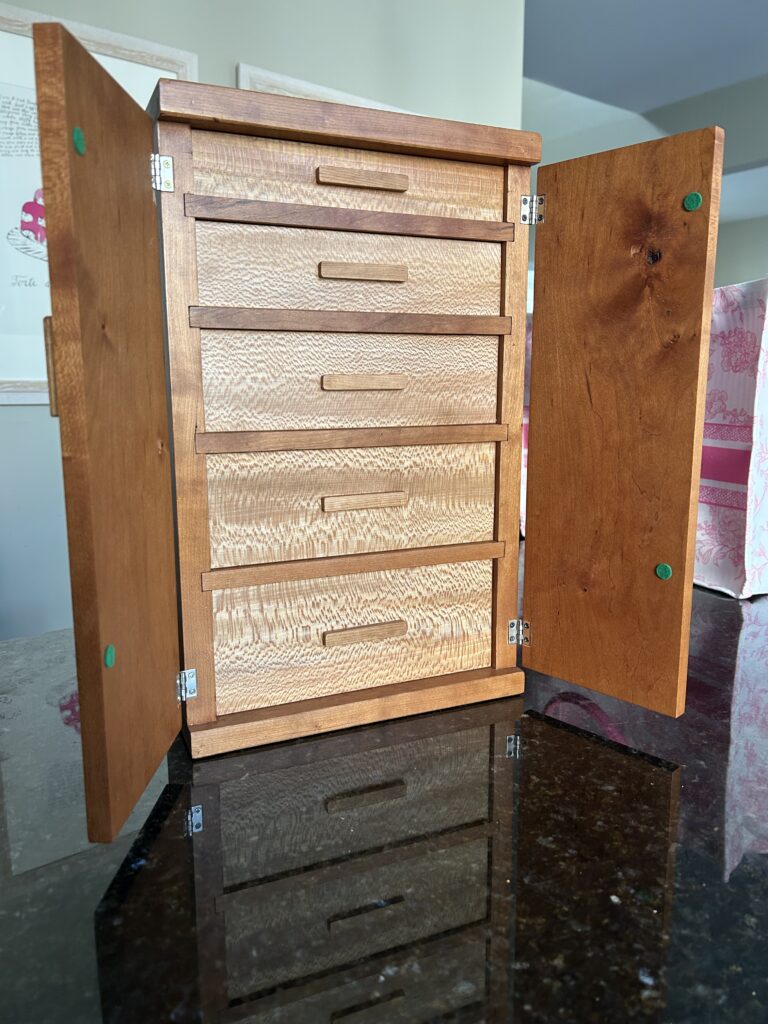
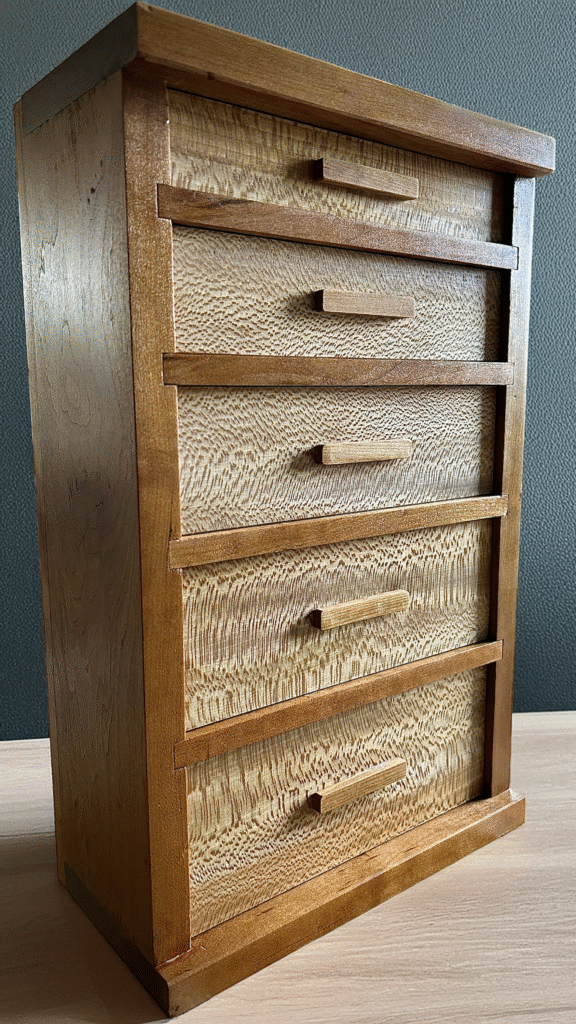
This is a prototype small cabinet that I designed and built to see if I liked the form, proportions, combinations of wood, and other things like how would this scale at different sizes. This piece is made from cherry (case) and quartersawn sycamore (drawer fronts), with some odds and ends used for the small drawer boxes.
Sometimes the best way to find out if something is going to work is to just build it and see. Even though its a prototype, it was still constructed well so it could actually be used.
The joinery for the case – holding the tops and bottoms to the sides were mortise and tenon. The dividers that partition the case are just set into through dados. Didn’t feel like going to the trouble to make stopped dados to hide the joint at the front. Anyway, if this were a shaker piece, you’d see maybe that or a half dovetail holding the divider/rail to the case side. The back is a solid slab that I just pinned in place with 1/4″ cherry dowels in a couple of places.
The doors were made from a single slab split in half. All the cherry came from the same set of boards so the color consistency and grain are, well, consistent.
The drawers are graduated in size, larger at the bottom, smaller at the top. The graduation was, I think, stepped down a half inch as you progress up. I did not spend a lot of time constructing the drawers. The boxes were made out of 1/4″ walnut scraps – mitered on the two back corners. I let in the drawer fronts to the sides of the box with simple dados at the front – but they are inset so you don’t see them – instead of using rabbets on the sides. I made a groove in the sides and a stopped groove in the front into which a bottom was fit.
For the pulls, I just cut some small pieces of cherry, lightly shaped them with a rasp and a bit of sanding. They are affixed with a couple small hidden dowel pins into the drawer fronts and doors. I added a slight chamfer to the fronts on all four sides that give a bit of a shadow line around them when you are looking at them inside the case.
That’s about it. I used cheap hinges, though, for the doors. I didn’t want to spring for about $100 bucks for some good brass ones for this. I mean, it’s a prototype. I finished it with about 5 or 6 coats of Sutherland Wells Botanical Tung Oil finish, then a couple coats of their tung oil paste wax.
Oh, the size of this prototype is about 14″ high x 8″ wide x ~4″ deep, give or take. I think I chose a golden rectangle proportion for the overall dimension – based on the stock sizes I had on hand to make it. If I were to make this again for real, I would do a few things different, but nothing major.
I would consider half blind dovetails for the drawers/fronts. You’re really only talking about aesthetics here in that regard at this size. These are so small, the mechanical properties are overkill. Just because you can do something does not mean you should.
I prefer to choose my joinery for reasons other than they might look pretty/show off how good (bad) I am at the craft. In fact, in most cases, I’d prefer that one never see the joinery in a piece, if at all possible. Who cares what kind of joint you use so long as its appropriate to the functional and structural needs of the piece, or whatever design you’re going for. So, in that respect, dovetails – they kind of insist upon themselves sometimes, no? Maybe at this small size, a small mortise and tenon. Or even pinned rabbets. Something else. Who knows. If the drawers were bigger, had to carry more weight, get more use, then yeah, dovetails are probably the way I would go for structural integrity and a long-lasting joint.
What else, what else… Oh, yeah, I think this could scale up to much bigger sizes, keep similar proportion. I think it can work as both a vertical or horiztonal piece. However, the interior compartmentalization – I think that would change depending on what the piece is going to used for. Clothes? Office supplies? Shrunken head collection? All depends. More/fewer compartments. Asymmetric interior division of space. Etc. That is all. Cheerio.