
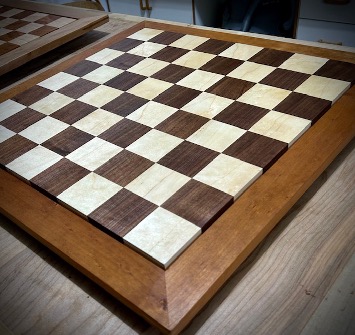
Before I can answer that question, you have to know what I mean by natural oil finish. So, this would be oils derived from natural products, like nuts or seeds, or grains… basically some form of plant life or constituent matter squeezed unmercifully until it gives up its vital essence, and not the carbonized remains of dead organic matter transformed under heat, pressure, and time, i.e., petroleum-based oils, black gold, liquified dinosaur. I get that crude oil is a natural product. You know what I’m getting at.
So, we’re talking about things like linseed oil, tung oil, walnut oil, etc. I tend to use the former linseed and tung oil-based finishes almost exclusively in some concoction – either store bought as a self-contained formulation or mixed up in the home lab all mad scientist-like. However, there are times I will use other things like shellac, which is a natural product, or a wax, like bees wax. Depends.
I almost never use things like polyurethanes, varnishes, lacquers, that kind of thing. The real stinky ones that by their very stench you know probably are not great to be handling or breathing in. I’ll leave aside a discussion on paint for another time so as not to get into a digression my editor will scold me about.
Now that you have a very basic sense for what I’m talking about. The answers to this one are pretty simple. In no particular order, they are easy to apply and almost impossible to screw up, unless you are not paying attention to what you are doing, in a rush and try to short-cut the process, or don’t follow the manufacturer’s instructions (i.e., operator error).
They are forgiving in their application, by and large. They are also forgiving of future repairs/restorations – spot fixes or otherwise. Why you ask? Well, for example, if you get a scratch or a water stain, you can deal with that with a bit of planing, scraping, or sanding or what have you and blend in a new coat(s) of the same oil finish. No need to strip or otherwise roll the entire project back to square one and start over. Anybody can do that, really, if so inclined, including the person who procured the object with only the most minimal of tools/skills.
In some sense, it’s about building repairability of the piece into the overall design. I think one ought to make their creations with that in mind, which I think I try to do in most cases. There are other ways to accomplish this but we’ll save that discussion for later.
I like the way they look on any type of wood. They allow the natural characteristics of the wood to be highlighted, not overpowered. See, the reasons are simple.
Now, one last bit and that has to do with what you have to accept a priori. No finish, aside from maybe encasing your creation in 6 inches of bullet proof glass surrounded by armed guards and rabid raccoons can prevent the accumulation of wear and tear. Live with how it ages, fix what can/should/needs to be fixed in the event of an unfortunate occurrence.


Leave a Reply