
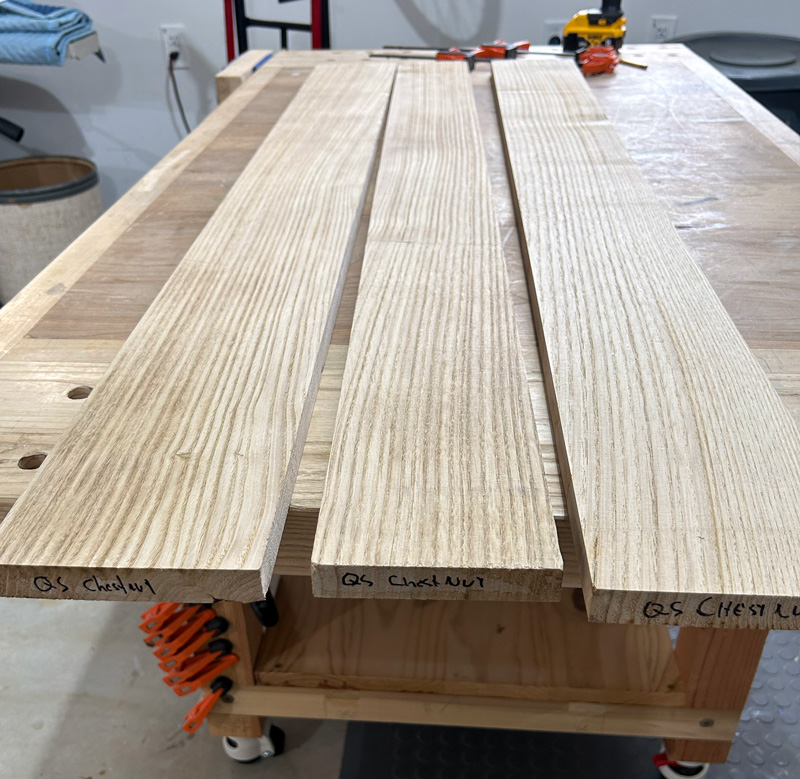
Now, that slight pun of a title actually has a purpose other than just an exercise in bad punnery, if you will.
I would like to use American Chestnut to build all manner of furniture, cabinetry, and other objects. However, American Chestnut is for all practical purposes, presently and for the last say 100 years, extinct. Therefore, this isn’t really an article about a current favorite wood and why I like to use it. This is more of an exercise in melancholia, history, and wishful thinking for future generations.
I use those terms ‘presently’; ‘all practical purposes’; and ‘extinct’ deliberately, which we shall now attend to in detail.
It’s probably safe to say that the majority of people currently inhabiting these United States have never seen an American Chestnut tree for real, in the Eastern forests where it once was the dominant deciduous species, in the manner in which it would have looked in its prime as a spectacular specimen of natural wonder.
Why? Chestnut blight. Accidentally introduced a long time ago when someone brought in a non-native species on a clipper ship that had the blight for which American chestnut had no resistance. Sound all too familiar at this point? It wiped out untold billions of trees in about a 50 year span. You can read more about that history elsewhere. It’s quite well documented. Here’s a link to the American Chestnut Foundation where you can read much more.
Now, wiped out and extinct technically are not the right words to use. There are still chestnuts out there – as standing trees, here and there. A few blight resistant ones that have somehow, someway persisted through a quirk of genetics, good luck, or a combination thereof. There’s also lots of what you wouldn’t call trees in the sense you’re likely thinking. More like stumps that are still alive, still send up new growth, but can’t grow that large before the blight attacks them.
So, what once was is currently, for all practical purposes, mostly, gone. It would have sure been a sight to see a 200 foot chestnut in the woods around the house I grew up in if they were still around then. I wonder if they would still have been appreciated in the same way as the are revered now that they are not around. However, mostly dead is not all the way dead.
The aforementioned American Chestnut Foundation has been working diligently, among others, over decades to try and bring it back in a blight-resistant form. Maybe with any luck they will eventually be successful. I won’t see it. You won’t see it. Your kids won’t. Or their kids, etc. But perhaps in a couple hundred years. Long when you compare it against our puny human lifespans, but in the grand scheme… a spec of time, but a whisper in geologic parlance. But, perhaps.
I’ve never built anything out of American chestnut, as I would say is the same for most. Yet. One can obtain reclaimed chestnut. It was used so much in the past that you can find it sometimes – old beams and boards from barns, reclaimed from old houses, that sort of thing.
Now for the twist. I have some American chestnut in my lumber stash waiting for the right project. I actually have two bundles. One was procured a couple years ago from a mill in the mid-west. They came into some virgin American chestnut from someone that had a few trees that, if memory served, were described as blight resistant specimens at the end of their lives. I have 20 board feet of 4/4 stock. It’s flat sawn, not the greatest in terms of knots and defects and such, but…American chestnut, nonetheless. Freshly sawn. Kiln dried. Exceptionally rare to almost unheard of to find. When I saw it for sale, I did not hesitate or consider the price. Sold.
However, as luck would have it, I got an email the other day from another supplier that specializes in highly figured woods for the instrument making trade and other discerning sorts. They posted on their site a stock of virgin quartersawn! American chestnut from a sawyer that at some point in the last couple of decades came to procure a single log from a blight resistant tree. I almost fell out of my chair. I saw the email within about 10 minutes of it being sent. I panicked a bit. What to buy… how much, ahh. However, I did not hesitate. Or consider the price. Sold.
I can only assume and hope this tree was at the end of its life and not still thriving and cut down by a maniac with dollar signs in the eyes. I now have approximately 7 board feet of exquisite Q/S chestnut to transform into something. And I have to say, man, that’s some wood. I don’t know what to do with it yet. Maybe I’ll save it for my own urn or something, though I’d much rather, when the time comes, be chucked into a hole in the ground underneath a new tree to help it grow big and fat off my no longer needed organic/inorganic elements/molecules. It would be quite fitting, as a worker of wood to have ones atoms persist and be incorporated into a new tree. A bit of immortality, I guess. Maybe someday that tree will itself come to pass and it and my atoms will become a table or chair in someone’s house. I should be so lucky.


Leave a Reply