
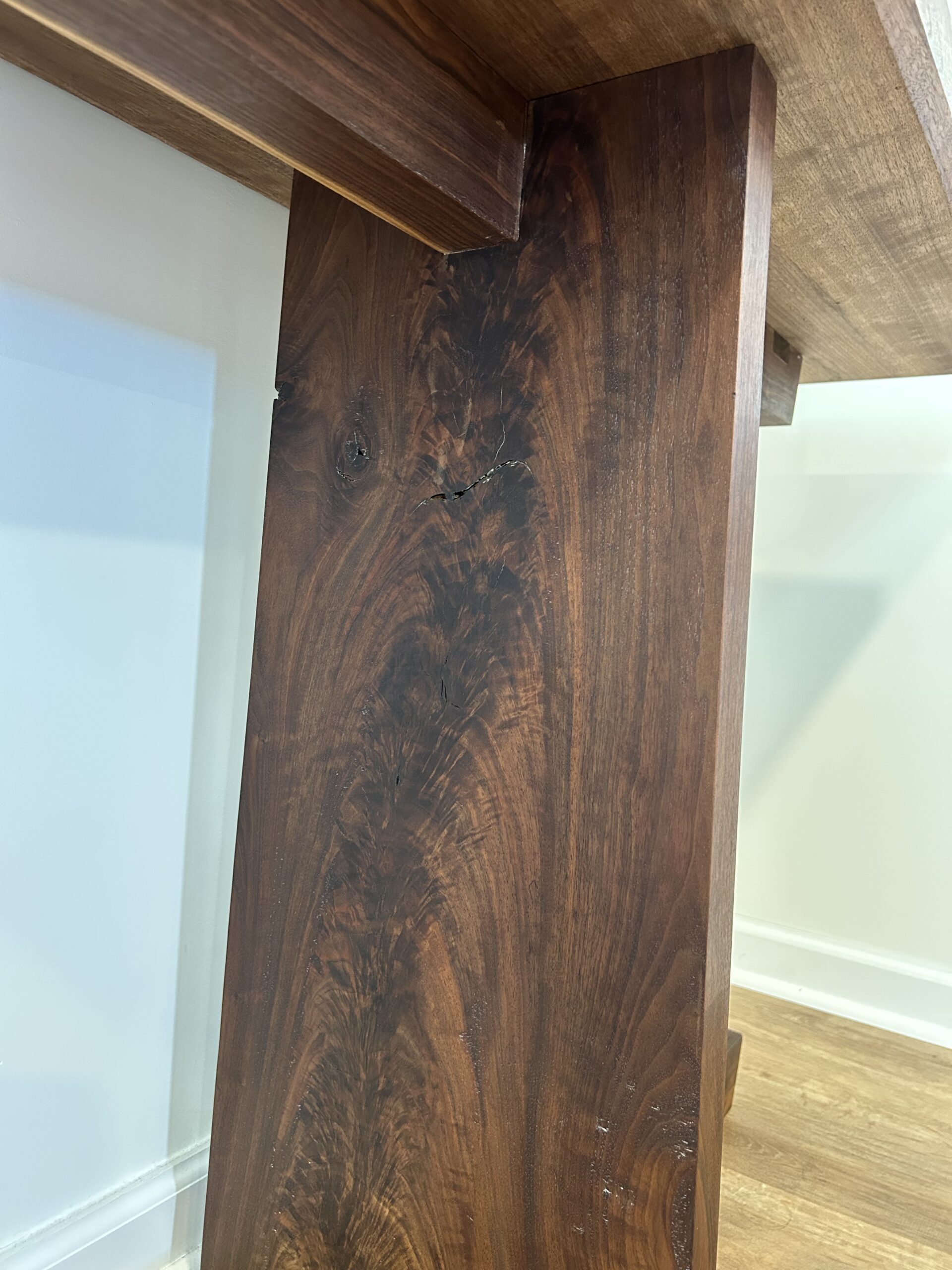
So, we meet again. This time, its walnut. Black. Juglans Nigra. I’m just going to use walnut here in place of black walnut for the sake of brevity.
I would wager if you lined up 100 wood workers and asked them what their favorite wood was, you’d probably hit at least 80 percent with this one. If you polled 100 wood workers who like to post their creations and constructions on YouTube – you’d probably hit 150 percent. More on that in a bit
I mean, yes. Walnut is delicious. It’s versatile. It is available in many sizes, shapes, and figuring. It is in demand and therefore commands a premium hit to your credit card. It works well, finishes well, people love the dark color. It is worth the price? It is if you like it. Simple. No value judgement here.
It’s not in my top five though in terms of using it for a personal project. However, if someone wants a piece in walnut, you’ll get no arguments from me about that. Can do.
Why is it not a personal top five? It has nothing to do with its properties as a furniture or cabinet wood. I just prefer other species usually. That’s not to say I don’t use it personally. I just won’t make everything out of it. I think I have one substantial piece right now that is purely walnut. Probably a few little boxes here and there. That’s about it. I tend to use it a little more sparingly and in combinations with other things where it’s not the dominant species.
Which brings me back to my opening paragraph and a bit of a digression of likely limited appeal. Why does it seem as if every wood worker on YouTube is having an extramarital affair with walnut? When did walnut become almost the definition of what a “fine piece of furniture” looks like? I mean, does it sell videos or products better? Is it what people expect to see? Is it just a case of monkey-see, monkey do? I don’t think less of any of these individuals and their creations. I just find it curious. I see a pattern, but I’m confounded as to why it exists.
Anyway…skipping around a bit, here’s one thing I hope not to hear, which is: ‘can you make this bunch of pine or poplar look like walnut’, you know, to save a few bucks. The answer is no. I cannot do that, nor will I try to do that.
You can’t cheap your way into walnut by using something other than walnut and staining or dyeing it or performing some other form of ancient alchemy upon its fibers. It does not work. You can darken another species, certainly, but you can’t make it become walnut. The grain won’t be walnut. The texture won’t be walnut. The way it reflects light won’t be walnut. Again, this goes entirely against the principle of not asking a particular wood to do a job or look a way it was never born to do or look. One simply has to accept this fact.
Skipping yet a bit more: you should know that walnut, unlike cherry, will lighten over time. How much, how fast? Depends. But it will get lighter in color/tone. You can probably minimize that to a degree with the type of finish and for sure keeping a piece out of direct, harsh, persistent sunlight is always a good idea regardless. Just accept the fact that it’s going to change, and age – gracefully. Think of it like your hair turning grey/white/silvery as time creeps in its petty pace. Don’t fight it. We can all spot a bad dye job a mile away. It’s natural. Happens to all the best people.


Leave a Reply