

I thought it would be a good idea to talk a little bit about the kinds of woods I like to use when making stuff. Of course, it’s all a matter of personal preference — but preferences driven by a number of variables.
As stated before, our mantra is domestic species, full stop. Yes, I know true mahogany is gorgeous, and durable. And who wouldn’t want an ebony clock a la The Masque of the Red Death bonging out the hours inside one’s drawing room while trying to avoid the next plague beside a crackling fire.
Can’t do it. Too many ethical implications for planet and people that I don’t want to be part of. Besides, we have everything we need right here in good old North America without needing to inflict any more suffering abroad than is already out there.
So, this will be an ongoing series of articles that touch upon a particular species of wood, how and why I like to use, and when, and maybe a little bit about the historical uses, scientific, and ecological background of said tree genus/species.
Part 1: Black Cherry
Black cherry is not the kind of tree from which delicious summer snacking is had. Different species altogether. I have no idea if the fruit tree would make for a decent wood for furniture and things. I should probably look that up. Furniture making cherry is, in the order of things, in the latin tongue, Prunus serotina (black cherry).
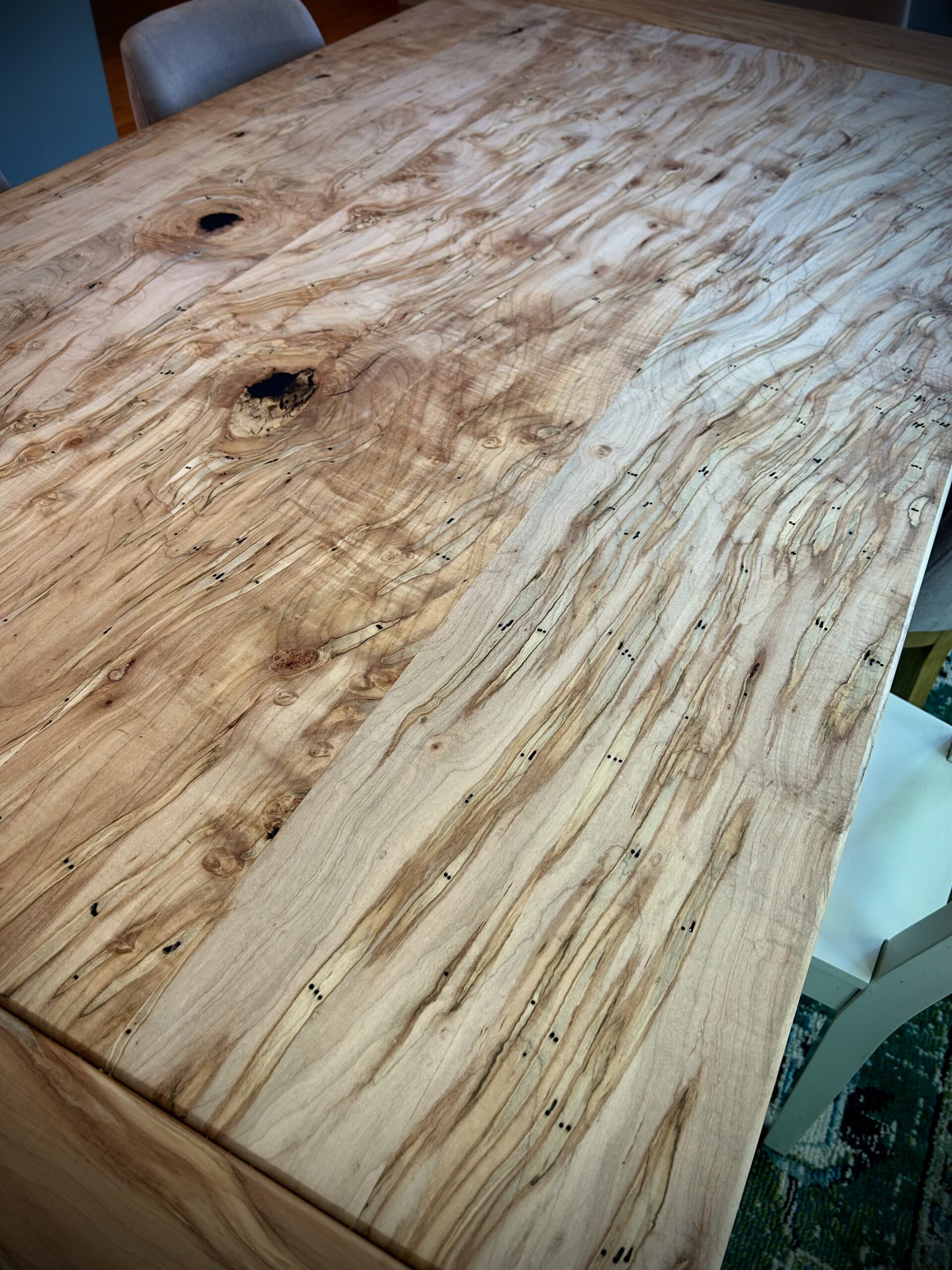
The color, the workability with all manner of tool, and how it takes a finish — particularly hand-rubbed oils and waxes — make it a pleasure to work with. It’s plentiful, too, and I can usually get long and wide timbers without much trouble in just about any thickness up to 12/4, locally. You can also find curly/figured cherry, but usually at a premium. Oh, and also “gummy” cherry, in which the boards have a lot of black gummy lines in it. Just a property of the tree. Some have it more than others, or not at all. It can look pretty cool, though. These are pretty good reasons to work with it. I would put it at or near the top of list of preferred woods. It’s also a bit less expansive than walnut or white oak. You can get it flat sawn and quarter/rift sawn. Also live edge slabs.
What kinds of things deserve to be made out of cherry? Ha. Anything. I think to say that cherry is only good for a certain kind of piece or vibe is nonsensical. I think that holds true for a lot of wood species. Maybe most. For someone looking for a piece of funiture, or to have one made all custom-like, I think if you’re looking at cherry you’re digging the color and what it will become over time more than anything. If you like cherry and want something in cherry, then by jove, you shall have it.
You should know that the color/tones of cherry are highly variable, tree to tree, board to board (not just cherry, but many others). It more often than not starts out pinkish in the heart wood, with lighter pinkish tones in the sapwood. However, without a shadow of a doubt, it will not stay pink. Oh no, there will be blood. Cherry will darken over time and become a much richer, deeper redish, brownish color. How fast will that happen? Depends on how much exposure to UV light and oxygen it gets. I can tell you, though, take a board, any board, plane it, set it out on a counter or anywhere really. Put over top a portion of it something that is oqaque. Another piece of wood, a brick, piece of neutron star you have lying about and wait. Check back in a couple weeks, remove said covering and behold the color change. Now think about that over time. Eventually the process will stop. But where, I hear you ask? Well, go look at some antique pieces and you’ll see.
One thing with finishing cherry is that it can be a bit blotchy in the way it takes finish. Some people don’t like that. It bothers me not a bit.
I say all this to reinforce the fact that one should not get too attached to cherry’s youthful pinkish hues for too long. It won’t stay that way. You have to understand and know that it will darken significantly. But I think that’s one of its great properties. You get to witness that evolution first hand.
So, taking things a step further, one works with the inherent properties of the wood as it presents itself. If you are always trying to change that with a species of wood you are working with, maybe try a different species. Why fight a battle with mother nature you have no hope of winning? Why try to force ones will upon the wood instead of adapating one’s approach to suit the substrate in question? Don’t ask the wood to change for you. The woodworkers job is work within the confines of what he or she has in front of them to produce the best possible outcome for the thing in question.
One Last Thing…From a purely woodworkers point of view, if one sees something interesting in some boards or a slab, and one really likes it but does not have an immediate use for it, get it anyway. Its likeness will never be seen again. Just do it. Don’t think about it. Get it. Stop thinking about it. Buy the damn lumber already before someone else does.

Leave a Reply